
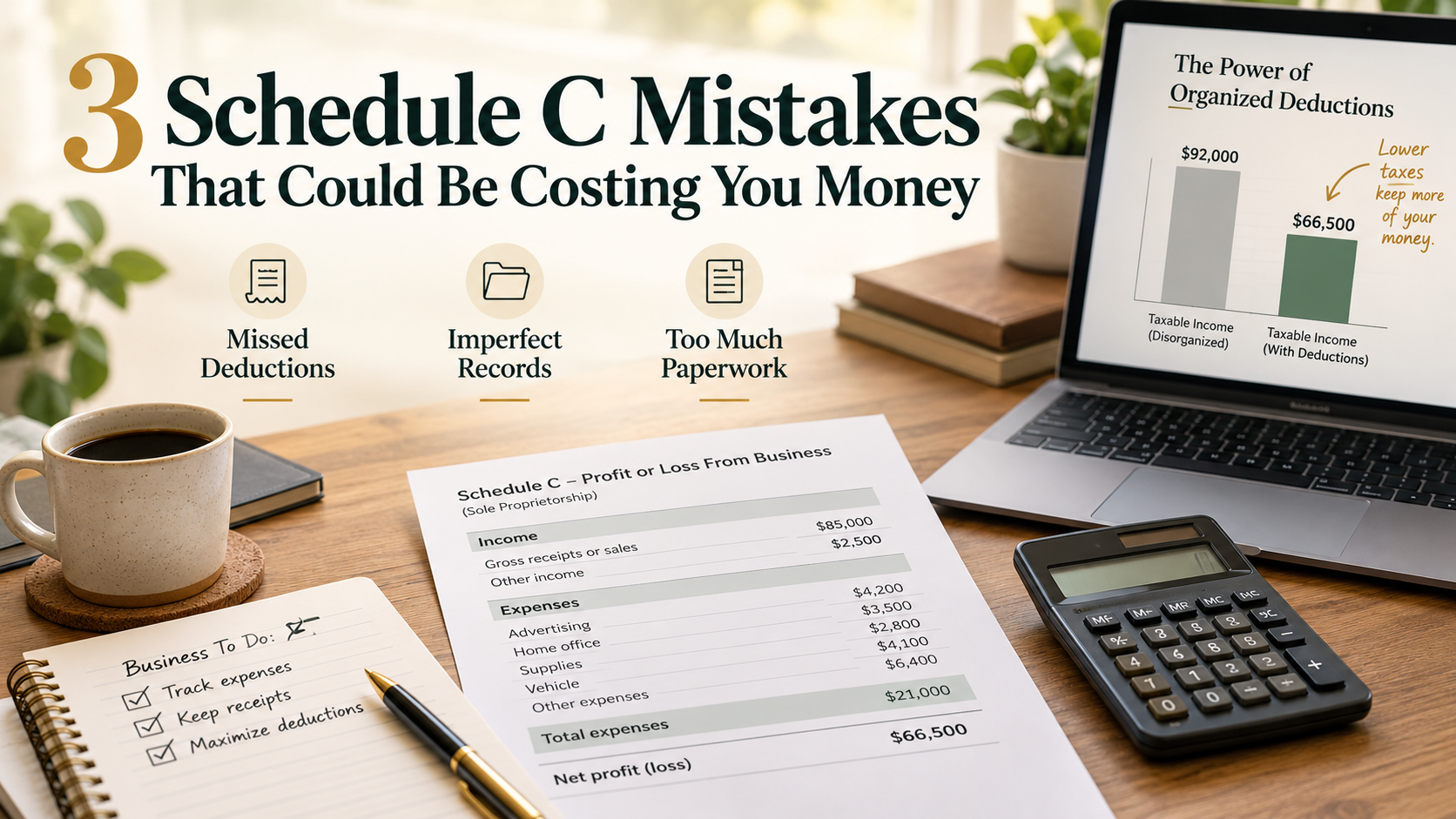
The Three Schedule C Mistakes That Could Be Costing You Money
If you are self-employed, a freelancer, independent contractor, creative seller, or sole proprietor, there is a good chance that at least part of your business activity is reported on Schedule C of your individual tax return. Find out if you are making these schedule C mistakes.
And after more than two decades of working with tax clients, I have seen the same Schedule C problems repeatedly.
Some business owners claim very few expenses because they simply do not realize what may be deductible.
Others know they had business expenses, but assume they have lost the deductions because their records are incomplete.
And then there is the opposite problem: business owners who arrive at tax time with bank statements, receipts, invoices, mileage information, online order histories, and seemingly every piece of paper connected to their business — but without an organized summary of what any of it means.
All three situations can cost you money, time, or both.
The goal isn’t to deduct nothing.
It isn’t to deduct everything.
And it isn’t to hand your tax preparer your entire business life and ask them to reconstruct it.
The goal is to identify legitimate business expenses, maintain support for them, and organize them into useful categories.
The IRS generally allows a business to deduct expenses that are both ordinary and necessary. An ordinary expense is common and accepted in your business, while a necessary expense is helpful and appropriate. An expense does not have to be absolutely indispensable to qualify as necessary. IRS
And those deductions matter more than many business owners realize.
Mistake #1: Not Claiming Business Expenses You Are Entitled to Claim
This is probably the most painful one for me to see.
A business owner earns money during the year, receives a 1099, and reports the income — but reports few or no business expenses.
Sometimes they simply don’t realize how many costs of operating a business can potentially be deductible.
Depending upon the business, expenses might include things such as advertising, supplies, software and subscriptions, payment-processing fees, professional services, shipping, business insurance, certain vehicle expenses, and other ordinary and necessary costs of operating the business.
Your exact deductions depend on your facts and circumstances, but the important point is this:
Schedule C generally taxes your net business profit, not simply the money that came through the door.
The IRS calculates net earnings from self-employment by reducing business income by ordinary and necessary business expenses. IRS
Here’s why that matters.
A simple example
Suppose a business had $10,000 of gross income during the year and the following legitimate business expenses:
| Expense | Amount |
|---|---|
| Advertising | $2,143 |
| Supplies | $1,786 |
| Software & subscriptions | $1,024 |
| Shipping | $843 |
| Total business expenses | $5,796 |
| Schedule C net profit | $4,204 |
Now compare that with reporting the same $10,000 of income and no expenses at all.
For illustration, let’s assume the taxpayer already has other taxable income placing the additional income in the 12% federal marginal tax bracket, qualifies for the full 20% Qualified Business Income deduction on this income, and has no other return items changing the calculation.
| No expenses claimed | Expenses claimed | |
|---|---|---|
| Gross Schedule C income | $10,000 | $10,000 |
| Business expenses | $0 | $5,796 |
| Net Schedule C profit | $10,000 | $4,204 |
| Approx. self-employment tax | $1,413 | $594 |
| Approx. federal income tax attributable to this income* | $892 | $375 |
| Approx. total federal tax | $2,305 | $969 |
| Difference | $1,336 |
That is approximately $1,336 of additional federal tax in this example simply because legitimate business expenses were not included.
The self-employment tax portion alone changes substantially because self-employment tax is generally imposed at 15.3% on 92.35% of net self-employment earnings. One-half of self-employment tax is also generally deductible in calculating adjusted gross income. IRS
*This is an illustration, not a prediction of anyone’s actual tax liability. Federal income tax depends on filing status, other income, deductions, credits, the QBI deduction and its limitations, and many other facts. If $10,000 of Schedule C income were someone’s only income, for example, the regular income-tax result could be very different, although self-employment tax may still apply.
The point isn’t that every $5,796 of expenses will save someone exactly $1,336.
The point is:
When you fail to claim legitimate deductions, you may be paying tax on money that wasn’t actually business profit.
And that is money I would much rather see stay with the business owner.
Mistake #2: “I Didn’t Keep Every Receipt, So I Guess I Can’t Deduct It”
This is the next conversation I have had many times.
A client knows they spent money on the business, but then says something like:
“I don’t have all my receipts, so I guess I can’t claim any of it.”
Not necessarily.
You absolutely should keep good business records, and the better your records are, the easier tax preparation — and any future substantiation — will be.
But a paper receipt is not the only type of business record.
The IRS identifies supporting documents such as invoices, account statements, credit-card records, canceled checks and other records that can help establish business transactions. Your records need to support both the amount involved and the business nature of the expense. IRS
Think about the electronic trail most of us leave now.
You may have:
bank records,
credit-card statements,
online purchase histories,
email invoices,
appointment calendars,
client records,
shipping records,
payment-platform histories,
or other documentation showing what occurred.
That does not mean you should simply estimate a pile of expenses because they sound reasonable.
It means imperfect records and no records whatsoever are not necessarily the same thing.
What about mileage?
Mileage is one area where I frequently encounter this issue.
Someone will tell me:
“I didn’t keep a mileage log, so I guess I can’t claim any vehicle expense.”
Ideally, mileage records should be created at or near the time the travel occurs. IRS guidance places particular recordkeeping requirements on vehicle and travel expenses. IRS
But sometimes legitimate business mileage can be reconstructed from reliable information.
For example:
“I traveled to the same client location 200 days during the year. The location is 15 business miles from my starting point.”
If calendars, client records, invoices, appointment histories or other evidence support those trips and the distance can be established, you may have something from which an accurate reconstructed mileage record can be prepared.
That’s very different from:
“I drove a lot for work. Let’s call it 10,000 miles.”
The goal is still substantiation, not guessing.
And once you realize how much information may still be recoverable from calendars, statements, emails, online accounts and other records, a messy year can sometimes look much less hopeless.
Mistake #3: Giving Your Tax Preparer Everything You Have — Instead of an Organized Summary
Then there is the other extreme.
The giant pile.
Receipts.
Bank statements.
Credit-card statements.
Amazon orders.
PayPal reports.
Etsy reports.
Invoices.
Mileage notes.
Emails.
And possibly a bag containing something purchased at Home Depot in March that nobody remembers anymore. 😂
Those documents may be important.
You should retain the documentation that supports the numbers on your return.
But what your tax preparer generally needs in order to prepare Schedule C efficiently is an accurate summary of your business activity.
The IRS itself describes a good recordkeeping system as one that includes a summary of business transactions, supported by the underlying documents. IRS
So instead of handing your preparer hundreds of individual transactions, imagine providing this:
| Schedule C category | Annual total |
|---|---|
| Gross business income | $10,000 |
| Advertising | $2,143 |
| Supplies | $1,786 |
| Software & subscriptions | $1,024 |
| Shipping | $843 |
| Business mileage | 3,217 miles |
You retain the supporting information showing how you arrived at those totals.
Your preparer receives a usable summary.
And if a question comes up — perhaps there is an unusual expense, equipment purchase, mixed business/personal item, vehicle issue, home-office question, or something else requiring additional analysis — then we dig deeper.
That is very different from asking your tax professional to perform an archaeological excavation through an entire year’s financial life.
The Sweet Spot: Keep the Evidence, Organize the Numbers
The best Schedule C preparation sits between the two extremes.
Don’t throw away deductions because your bookkeeping wasn’t perfect.
Don’t claim expenses you cannot reasonably support.
And don’t assume that good tax preparation means delivering every document you possess to your preparer.
Instead:
Find the legitimate expense.
Determine its business purpose.
Keep or reconstruct appropriate supporting information.
Categorize it correctly.
Summarize the totals.
That is exactly why I created my own Schedule C organization tools.
After years of seeing business owners either miss deductions, give up because their records weren’t perfect, or become overwhelmed trying to organize everything at tax time, I wanted to create something closer to what I actually want to receive when preparing a Schedule C.
Not a shoebox.
Not zero expenses.
A workable business summary backed by good records.
Because the objective isn’t merely to complete another tax form.
It’s to prepare an accurate return without unnecessarily leaving your own money on the table.
I’ve sat on the other side of the desk for more than two decades. I’ve watched business owners leave legitimate deductions off their returns, assume imperfect records meant they had no deductions at all, and overwhelm themselves trying to hand over every receipt and statement they could find.
That is exactly why I created my Schedule C organizer.
It is designed to help you turn a year of business activity into the kind of clean, workable summary your tax preparer can actually use — while still keeping the supporting records behind the numbers.
If you know your records are scattered, you are not sure what categories to use, or you simply want a better way to prepare for tax time, this can help you get organized without turning the process into a second job.