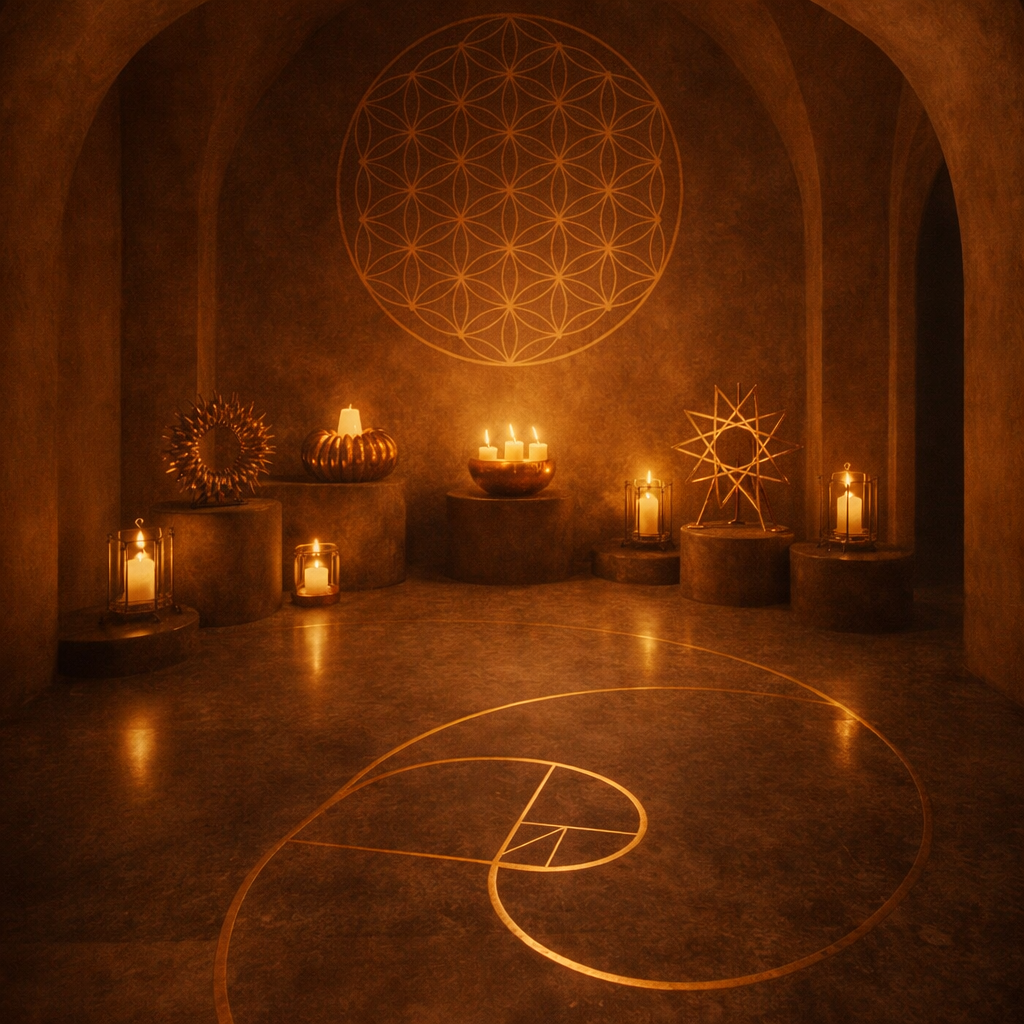
The Antechamber: Why Your Life Feels Empty Right Before It Changes
There is a particular kind of quiet that arrives before a life rearranges itself.
Not the quiet of giving up.
Not the quiet of depression.
>Not the quiet of confusion.
But the quiet of architecture.
The kind that happens when old structures have already been dismantled…
but the new ones are still being assembled beneath the surface.
Many people mistake this season for failure.
>They call it being stuck.
They call it loneliness.
>They call it losing momentum.
But in older languages, this space had a name:
The antechamber.
A room before the great hall.
A threshold before entrance.
A private space where the body, identity, and direction recalibrate before crossing into what comes next.
When “nothing is happening” frequency is forming your new life
Modern culture teaches us to measure life by visible motion:
Progress.
Output.
Announcements.
Momentum.
So when life becomes quieter, slower, more selective…
we assume something has gone wrong.
But internally, something very precise is often occurring.
Your nervous system is changing altitude. Values are reorganizing. Tolerance for distortion is lowering. Your sense of identity is becoming more coherent. Your frequency has changed and your life is catching up.
This kind of change does not announce itself with fireworks.
It announces itself with emptiness.
Less appetite for noise.
>Less attraction to familiar patterns.
>Less energy for relationships that once felt central.
Not because your heart is closing…
…but because your life is restructuring.
What the antechamber actually is
An antechamber was never meant to be lived in permanently.
It was designed as a space of:
• preparation
• recalibration
• identity shift
• nervous system settling
• symbolic death of an old chapter
It is where the dust of the previous life settles out of the body.
Where old emotional contracts dissolve quietly. Roles you once played stop fitting. Where attraction changes texture. Where ambition softens into clarity.
It is private by design.
There is no audience for becoming.
Signs you may be in an antechamber season
You may notice:
• A gentle loss of interest in relationships that once consumed emotional energy
• A desire for more physical space, land, quiet, or simplicity
• Work becoming instrumental rather than identity-defining
• A reduction in urgency
• Less tolerance for emotional chaos
• A pull toward embodiment, rhythm, and nervous-system coherence
• A strange mixture of grief and relief
You are not disappearing.
You are recalibrating.
Why rushing this phase damages what comes next
The antechamber is uncomfortable for one reason:
It does not offer immediate replacement.
Old structures fall away before new ones appear.
And many people, frightened by that gap, rush to fill it.
They reattach to old dynamics.
>They accept partial relationships.
>They overwork.
They relocate prematurely.
>They chase stimulation to avoid the quiet.
But a life built on unsettled ground will require constant repair.
The antechamber exists to prevent that.
It is the phase where your internal geometry is corrected.
Your center of gravity is redrawn.
Your field becomes coherent enough to support what you are actually meant to hold.
The role of structure: why form matters during transition
During identity shifts, the body looks for anchors.
This is why many people are drawn to:
• sacred geometry
• ritual
• breath
• physical practices like yoga
• frequency-based art
• intentional sound
Anchors calm the nervous system.
They tell the body:
You are safe to reorganize.
This is where physical forms become allies in invisible change.
A torus coil in a room is not a decoration.
It is a reminder of how energy organizes itself when coherence returns.
Sacred geometry on canvas does not speak to the mind.
It speaks to the body’s pattern recognition.
Sound recordings designed around polarity and integration do not fix you.
They help the nervous system complete unfinished loops.
Even certain yoga postures — grounding stances, spinal alignment, heart-space opening — restore orientation during internal transition.
These are not aesthetic preferences.
They are stabilizing technologies for the in-between.
You are not meant to perform this season
The antechamber is not a branding opportunity.
It is not meant to be optimized.
It is meant to be inhabited.
Quietly.
Privately.
With dignity.
This is where:
You stop negotiating your worth through proximity.
>You stop collapsing your boundaries to maintain connection.
>You stop rehearsing old identities for familiar approval.
You become gravitational again.
Less electric.
>Less reactive.
Less available to distortion.
More centered.
>More spacious.
More internally governed.
A different way to interpret emptiness
Emptiness is usually read as absence.
But in structural terms, it is capacity.
It is load-bearing space.
It is the room required for a different life to arrive without breaking you.
You are not being delayed.
You are being prepared.
Not by force.
By coherence.
Closing: orientation, not waiting
You are not standing still.
You are standing inside the blueprint.
This season is not asking you to strive.
It is asking you to stabilize.
To become trustworthy to your future self.
To let the architecture finish.
And when the next door opens —
it will not feel like escape.
It will feel like recognition.
Like entering a room your body already knows how to inhabit.
That is what the antechamber prepares.
Not change.