Repression Becomes Pressure: How the Shadow is Created
We were never taught how to hold every part of ourselves.
Anger that was inconvenient. Grief that made others uncomfortable. Desire that didn’t fit the story we were allowed to tell. Sensitivity that was called “too much.” Power that had nowhere safe to land.
So we learned to place these things somewhere quiet.
We placed them in the body.
Not as punishment. Not as weakness.
But as a form of survival.
What repression actually does
Repression is often misunderstood as denial — pretending something isn’t true.
But in lived experience, repression is more subtle than that.
Instead, it is the moment when the nervous system decides:
“This part of me is not safe to express here.”
So the emotion is not destroyed. It is delayed.
And what is delayed must be stored.
The body becomes the archive.
The jaw holds unspoken words. The diaphragm holds swallowed anger. The hips hold unlived movement. The chest holds unexpressed grief. The belly holds disallowed fear.
Therefore, what consciousness cannot integrate, tissue carries.
This is not metaphor.
It is architecture.
Pressure is frozen life
When emotion cannot move outward, it turns inward.
Energy meant for expression becomes energy under compression.
This is why repression often feels like:
• tightness without a clear cause
• heaviness in the chest or solar plexus
• chronic fatigue
• shallow breathing
• jaw tension
• digestive disturbance
• vague anxiety
• a sense of being “dense” or inwardly crowded
Not because something is wrong with you.
But because something true couldn’t complete its motion.
Life energy—emotion, energy in motion—wants to move.
When we force it to stay still, it becomes weight.
Why “staying positive” often increases pressure
Many people try to heal by becoming brighter.
More spiritual.
And more grateful.
More forgiving.
And more elevated.
But if one layers light on top of what is unfelt, the shadow is not liberated.
It seals it in.
Unexpressed anger beneath forced serenity becomes tension. Unwept grief beneath optimism becomes heaviness in the heart. Unacknowledged fear beneath confidence becomes hyper‑vigilance.
The body knows the difference between transcendence and bypassing.
It registers bypassing as another form of containment.
Healing is reintegration, not removal
The goal is not to eliminate the shadow.
It is to give it a voice again.
Allowing what was exiled to re‑enter the field of awareness without punishment.
This is what real integration looks like:
• allowing anger to be information
• grief softens the chest
• desire to exist without justification
• allowing fear without shame.
When expression becomes safe, pressure dissolves naturally.
Not because we force the body to release….
but because the body no longer needs to hold.
Polarity and the architecture of wholeness
Yours, and every other psyche is structured by polarity:
light and dark safety and danger permission and prohibition power and restraint
When you reject one side of polarity, the system loses coherence.
Energy bends. Movement distorts. Posture changes. Breath becomes shallow.
Reintegration is the return to symmetry.
Not perfection.
But balance.
This is the foundation of the Torus Polarity Process™. It creates a safe internal field where opposing parts of the self are witnessed without collapse, so that life energy can circulate again instead of accumulating as pressure.
Sound, geometry, and nervous system permission
The body does not release through logic alone.
It releases through pattern.
Through rhythm, shape, and through frequency.
This is why certain forms — spirals, toroidal flows, harmonic ratios — appear again and again in sacred architecture and healing traditions.
They are not decorative.
They remind the nervous system how order feels.
Sacred geometry on canvas acts as a visual stabilizer.
It offers the body a non‑verbal memory of coherence.
Sound functions the same way.
Carefully designed recordings — polarity work, deep hypnosis, quantum stream audio — create conditions where guarded parts can soften without being interrogated.
The body opens when it does not feel threatened by understanding.
The role of the body in shadow work
Shadow integration is not necessarily a mental project.
It is a physical one.
This is why practices like yoga, breathwork, and slow somatic alignment are so effective.
They do not demand explanation.
They invite sensation.
Certain postures gently restore regions where repression tends to accumulate:
• hip openers for stored emotion • spinal extension for suppressed voice • grounded standing poses for fear • heart opening postures for grief
Movement gives the shadow somewhere to go.
A gentler definition of wholeness
Wholeness is not brightness.
Instead, it is permission.
Permission for all of your emotional weather to pass through the body without becoming architecture.
Without becoming posture.
Without becoming illness.
And without becoming identity.
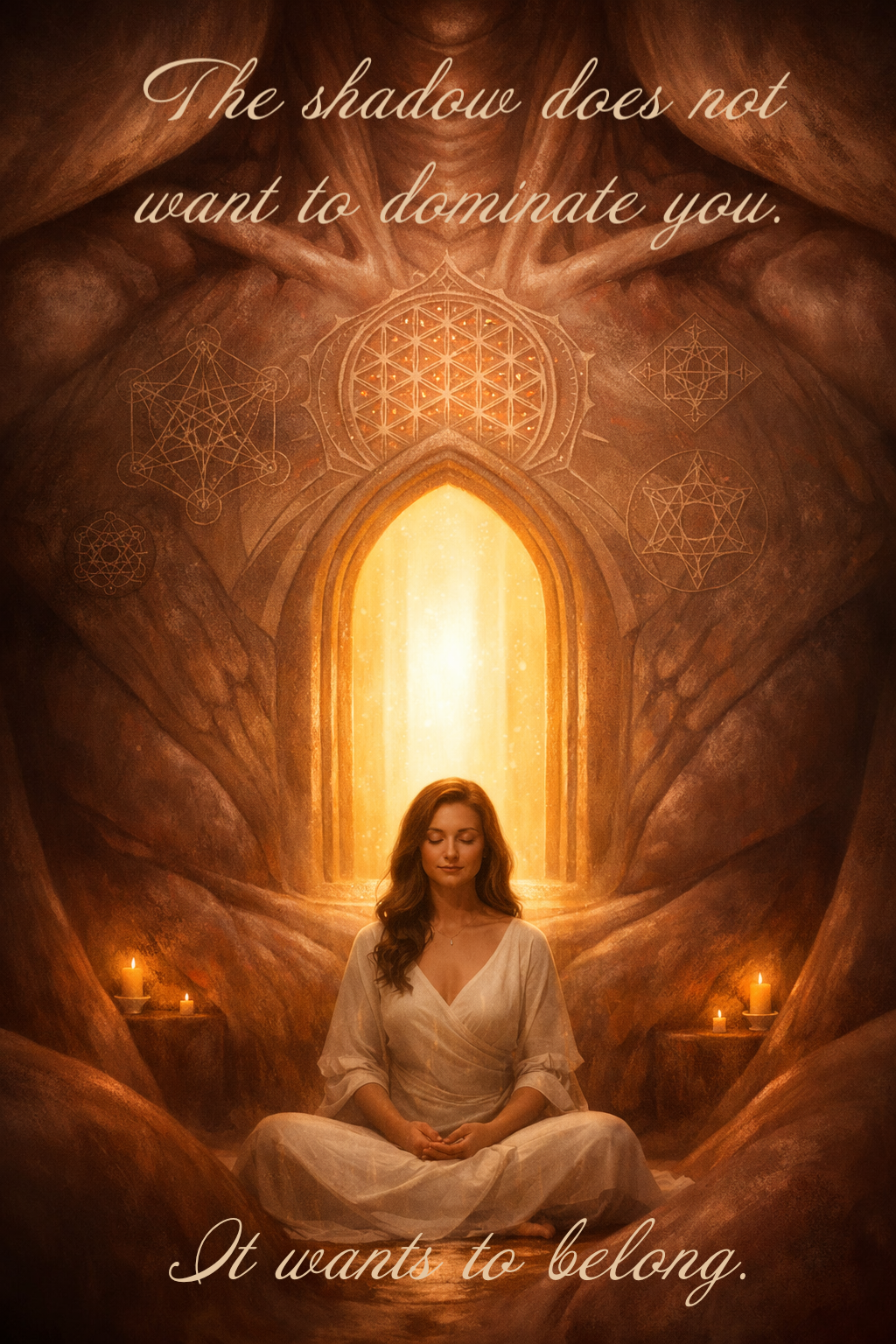
The shadow does not want to dominate you.
It wants to belong.
Closing
If you feel pressure in your body that no amount of positive thinking relieves…
Or tired in a way rest does not fully touch…
If you sense that something in you has been holding for a long time…
There is nothing wrong with you.
Instead, your body has been keeping what your life once could not receive.
Healing is not the act of becoming lighter.
It is the act of becoming spacious enough to hold the whole truth.
And therefore truth is allowed to move again,
pressure becomes breath.
And the body remembers how to soften.